


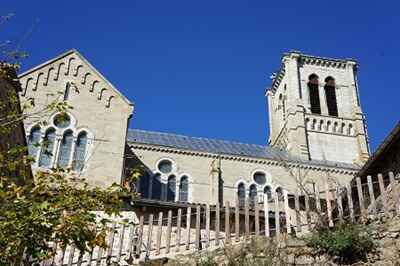
 On the morning of the third day, we wake to a gray and cold sky. At only two degrees, the few drops from the sky, hesitant in their weeping, seem thick; snow does not feel far away. This is our wake-up call as we ascend the streets of Pradelles toward the café.
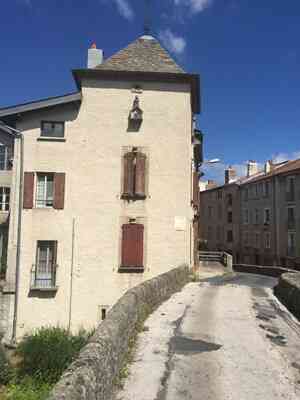 Descending between the stone houses, surrounded by the smell of a bakery, brings me back to village life a few decades ago. Today, however, the deserted alleys, despite being excellently maintained, sadly display an impressive number of "For Sale" signs.
Langogne is not far away. A descending path leads quietly towards it before joining the main road on the bridge at the town entrance. This is where the departments of Haute-Loire, Ardèche, and Lozère—which we are now entering—converge. Mende, its prefecture, is one of the smallest in France, but its wild and deserted landscapes, bordering Aveyron, speak to independent spirits. My brother and I were greatly guided by them on this journey.
For now, the situation is rather strange: we are advancing between cars and shop windows. This boulevard once knew another era, featuring ramparts instead of asphalt. Meanwhile, we wait for Pierre—who, being a former English teacher, has gone in search of an original language edition at the bookstore—as well as other lost group members lingering in cafés or bakeries.
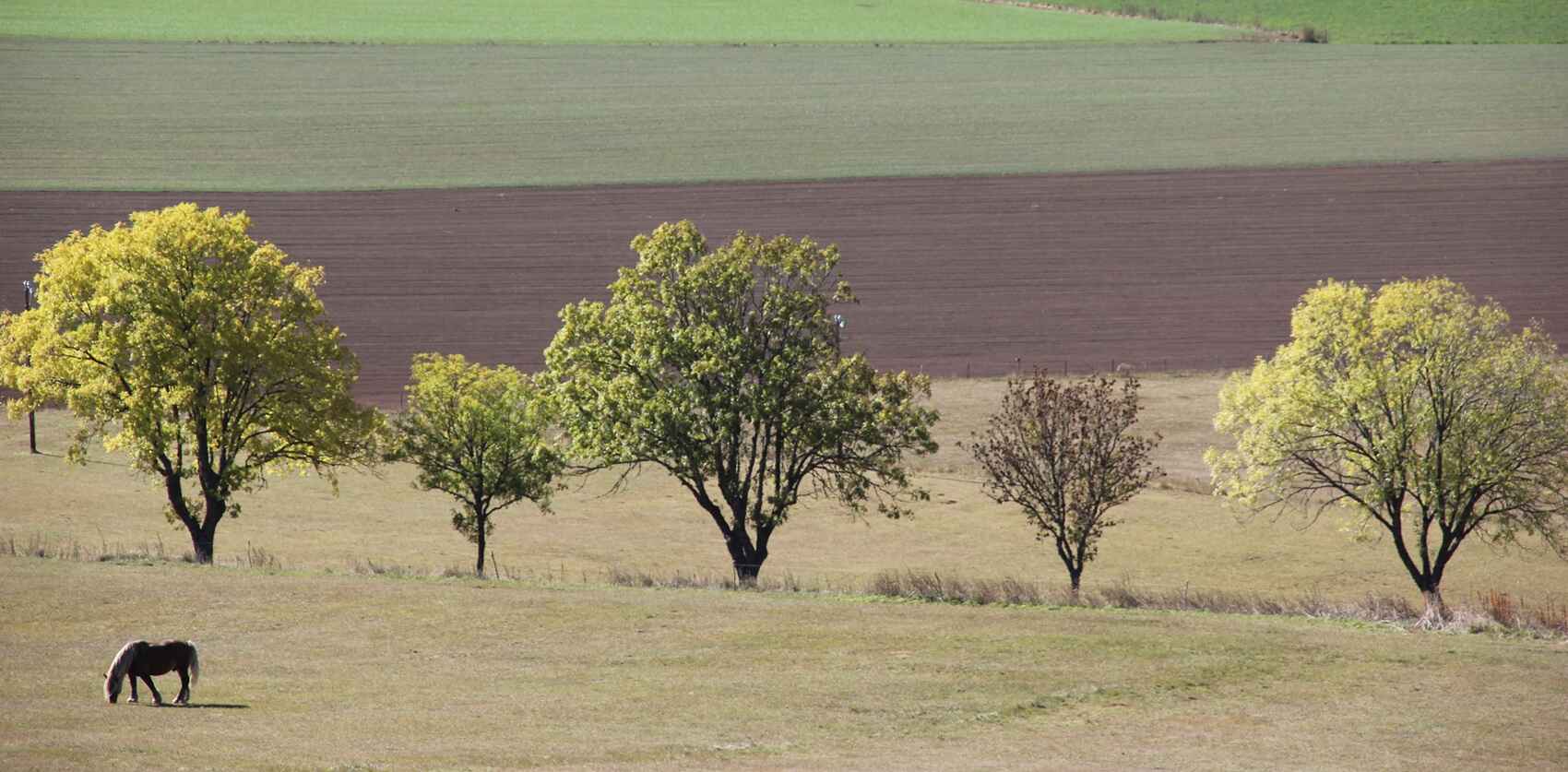
We leave the relatively bustling town via a charming, narrow, and arched old bridge. A brief stretch of asphalt leads us to dirt paths and the final cultivated fields. Beneath a gray sky hovering over the plowed land, Scots pines add their dark green tops and salmon-colored trunks to the scenery. They are becoming increasingly numerous.
In Saint-Flour-de-Mercoire, Saint Roch watches over the crossroads near the communal oven and the washhouse. The church, on the other hand, is tucked away. We find refuge under the washhouse roof to enjoy a picnic. In this small village, a local theater association has caught the interest of our actor friend; a note left on the door and the horseshoe tracks of his large gray donkey confirm he is ahead of us. Some Belgian hikers are also here, having arrived by car to walk a section of the trail. Pierre, our photographer, overtakes us and pauses further ahead to take a few shots while we resume our march.
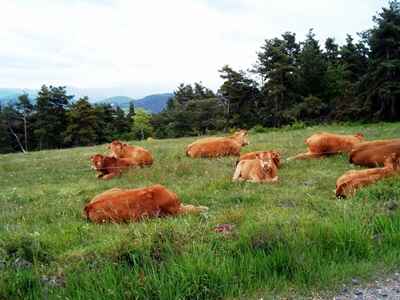 Fouzillic and Fouzillac marked Stevenson's journey as inhospitable places of bewilderment. Even today, fog blankets the heath between the pines and broom. The path loses itself among tall grasses and marshes, bringing our souls closer to the troubled state Stevenson experienced during his own wandering.
Our approach to Cheylard-l'Évêque is hastened by the rain. The Refuge du Moure, where we quickly seek shelter from the cold and wet, welcomes us for the night. The hostess is friendly, and the wood-paneled dining room is particularly cozy: jars of homemade jam sit on shelves, a small bar occupies a corner, and photographs of Antarctic expeditions line the walls, serving as invitations to escape.
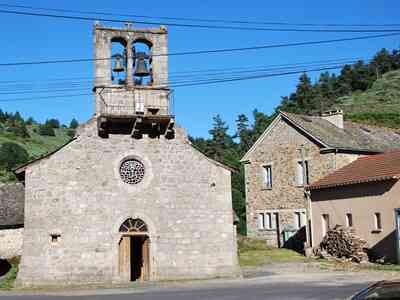 Pierre dines with us. A few brave souls who aren't too exhausted cut their meal short to attend a revised and adapted theatrical performance of Stevenson's Travels. We have indeed reached an authentic stop on the Scottish writer's route, and our actor friend is performing here tonight. The solitary actor's performance, supported by his companions' audiovisual techniques, is captivating and especially appreciated in the atmosphere of this small, rain-swept village. This directed interpretation of the original work will spark lively debates the next day regarding our respective viewpoints and perceptions. A friendship drink offered by the municipality concludes the evening, before we quietly slip into the darkness of our rooms.
A generous self-service breakfast buffet, featuring everything one could wish for, kicks off the day with energy. All the more so since the rain has cleared, giving us plenty of time to explore the village of Cheylard-l'Évêque. The chapel overlooking the town fades behind us, standing watch above the treetops lining the path. This building, much like the village's name, serves as a reminder of the former holiday residence of the bishops of Mende.
The route passes through pine forests, lush green valleys alongside streams, and steep paths overlooking wooded hills, with very few houses in sight. The group has split up: the vanguard moves quickly while foraging for mushrooms, while only three of us remain in the back, "lingering".
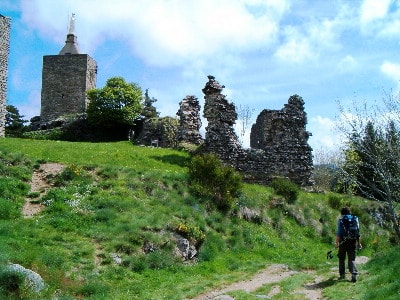
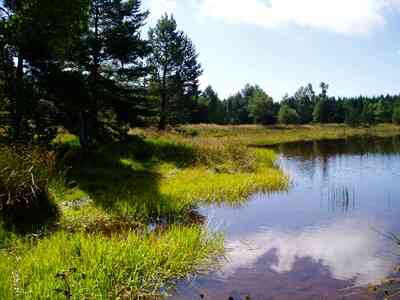 A shelter on the edge of a lake prompted the frontrunners to wait for us there, especially since it isn't particularly warm. Spontaneous conversations strike up among the hikers, and we set off again toward the ruins of the Château de Luc. Laurent, who is traveling in the theater troupe's tech van today due to tendonitis, comes to meet us—a welcome sign announcing our midday destination. In the heart of the ruins, a cool wind blows despite the sunshine. Everyone wanders off in their own direction, either to curiously explore traces of the past or to seek refuge behind the protective walls.
Christophe, the solitary actor, falls in step with the last of us for the descent into the village. It is an ideal opportunity to continue our dialogue from the previous day, revive Stevenson's spirit, and debate the various interpretations of his work. Unfortunately, our paths diverge here: since the author stopped in Luc, the theater troupe stays there, while we continue our journey toward La Bastide-Puylaurent, which we must reach by evening via the Abbey of Notre-Dame-des-Neiges.
In Luc, an old barn independently catches the attention of Pierre, Denis, and myself, ending up on the film of our respective cameras without any prior coordination. The harmonious arrangement of its stones immediately draws the eye, and its impressive age is confirmed by the date engraved on the door, pre-dating 1700.
 The first part of the afternoon stands in stark contrast to the morning. Wedged between the road and the railway, the route seems to bring us closer to civilization and is certainly much busier. Nevertheless, large abandoned summer camp buildings—at least we hope they are abandoned, as their "barracks-like" appearance is somewhat intimidating—bear witness to humanity's retreat even along major communication routes. Regardless, our best option is to distance ourselves from them. Bathed in sunlight, we begin our ascent up the mountain overlooking the Abbey of Notre-Dame-des-Neiges. Having lost track of the trail markers, we forge our own path, bringing us closer to Stevenson's mindset, who also wandered without a strictly dictated route.
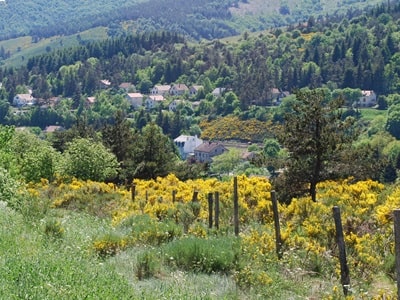 The panorama opens up widely toward La Bastide-Puylaurent and Mont Lozère, but the monastery roofs hide their tranquility behind tall conifers until the very last moment, as we approach the building from the rear. I savor the shaded calm of the grounds while the others go exploring according to their tastes: the bookstore, the church... or the bar! It is worth noting that these monks age their own vintage here, produced from their vineyards in the Gard region, in Bellegarde.
Denis, who is not feeling well, scouts ahead alone, and the rest of the group gathers for the final stretch of the day, which feels incredibly long. A hiker comes toward us: it is Pierre, our photographer. He had planned to sleep at the monastery just like Stevenson did, but this is no longer possible, as accommodations are now exclusively reserved for retreatants.
Arriving in La Bastide-Puylaurent, despite some prior scouting, I hesitate for a few moments before finding L'Étoile Guesthouse. Finally, we arrive at the home of Philippe Papadimitriou, the "friend" so frequently mentioned by Christian, a prominent and highly esteemed member of our association. Is he as I had imagined? Yes and no... actually mostly no, though he is certainly not a disappointment. And what about me? Do I match the image he formed over the phone?!
Our host has a highly unconventional background, and every corner of his home reflects it. From the warmth of the roaring fireplace to the piano standing in the corner, the freshly picked porcini mushrooms pan-fried with garlic and herbs, the shared meal, and the Belgian beers... all the ingredients are there for a lively discussion between him and Denis: "What if we reinvented the rural world?" Pierre reads peacefully by the fire. Some have already gone to bed. As for us, what world are we in? Oscillating between past and present, between local roots and universality, the evening stretches on in this beautiful, remote corner of Lozère, yet completely connected to the rest of the world by a well-traveled host passionate about the internet.
by Catherine Revel