


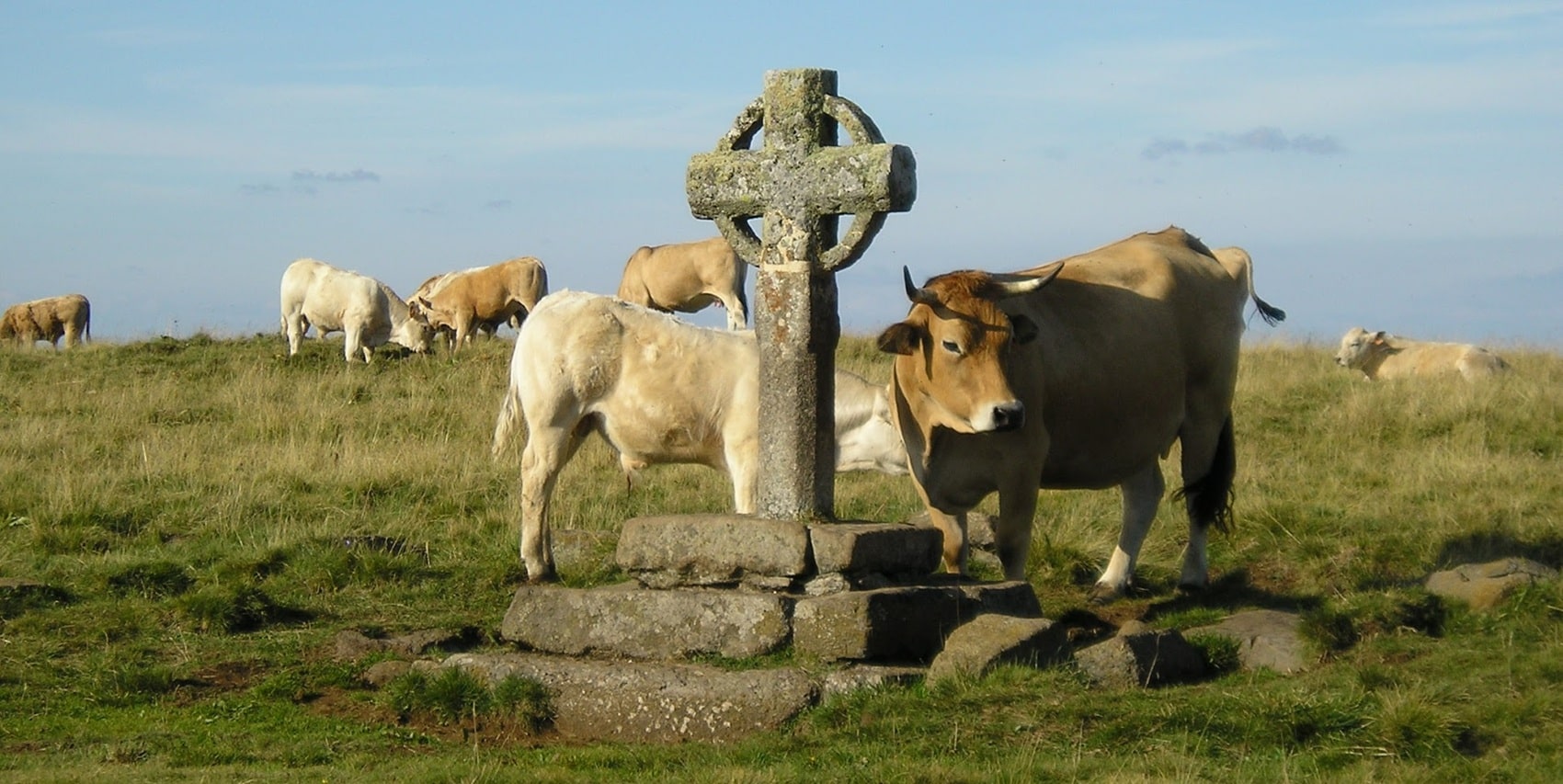
“In Aubrac, you truly feel the air.
Nowhere else have I experienced such a profound sense of being immersed in it.
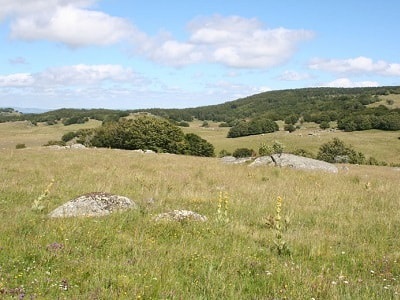
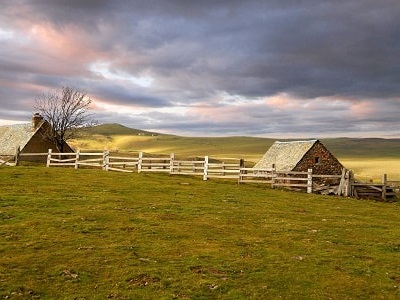
I cannot quite explain it: undoubtedly, it is the setting itself—its long, bare pastures devoid of a single tree, with only the rare and peculiar silhouette of a basalt rock emerging from time to time.
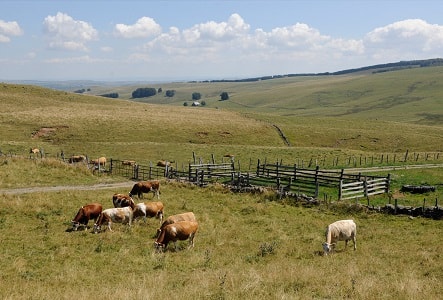
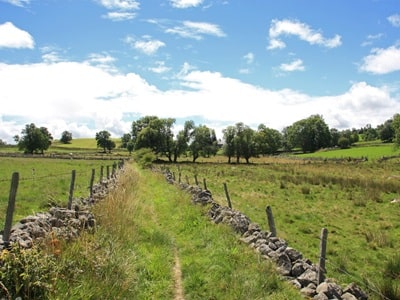
It is a landscape of endless ridges and wandering herds of cows roaming freely without a dog, tracing lines between endless strings of gray stones.
That is it, yet above all, it is this crystalline clarity, this raw taste of the wind, of bitter herbs, of melting snow... a pure taste of space.
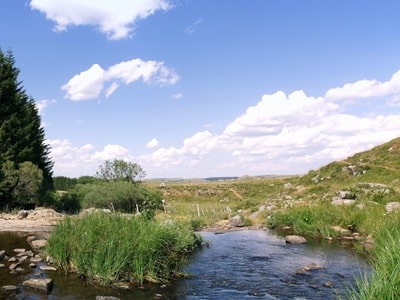
Yes, its clarity, its solitude... and its paved rivers where the icy waters of trout streams rush over hexagons of basalt...
It is hard to put into words... But Aubrac! Ah! Aubrac! ...”
Henri Pourrat
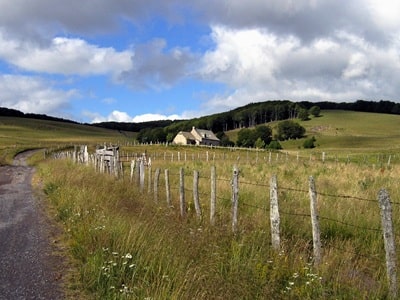 A unique land shared between the departments of Aveyron, Cantal, and Lozère, which converge at the historic Cross of the Three Bishops, Aubrac is a vast granite plateau perched between 1,000 and 1,400 meters in altitude. A realm of silence and open space sculpted by the mysterious forces of the elements, Aubrac captivates the soul as the gaze loses itself in the infinite horizon. It is only through the steady rhythm of our footsteps that we can truly immerse ourselves in its boundless character. Here, we discover its sweeping moors, a flora ranked among the richest in Europe, and deep forests where, in early autumn, the primal rutting call of the stag reverberates. We encounter its streams dotted with lakes and cascading waterfalls, framed by ancient granite and basalt stones. A harsh and demanding land, it forges strong, resilient bonds with those who inhabit it, shaping a people in its own image.
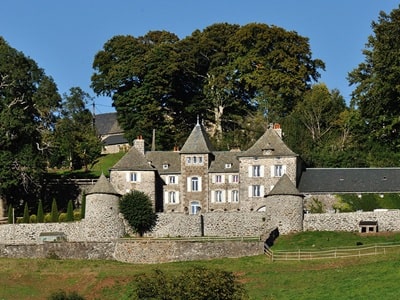
The Romans, the Pilgrims of Saint James of Compostela, the monks, and the farmers leading their herds to summer pastures have all left their mark on its heritage—leaving behind burons, timeless villages, Romanesque churches, and ancient stone bridges—yet without ever stripping away its inherently wild nature. It is a land of mystery with an unfathomable heart; to walk towards it is to journey deep within oneself. This hiking adventure is an invitation to experience it firsthand.
This brief text, written to announce our journey in an associative journal, also carried a deeper, more personal objective: to inspire a profound love for a region I hold dearly, my heart having been tied to these landscapes since childhood. The choice to wander over several days perfectly aligns with this desire for true immersion. It fulfills the hope that each participant would deeply absorb the soul of this land—an essence that is fundamentally indescribable and resonates differently with everyone—while discovering its most characteristic and breathtaking facets.
Autumn seemed to be the perfect season to convey this vision. It lends striking, contrasting tones to the environment, transforming both the vegetation and the ever-shifting skies. It is the time of the deer rut; the herds are still out to pasture, and Aubrac remains vibrantly alive, yet peacefully free of summer crowds and cars. A small group of kindred spirits shared this desire, willing to embrace the physical effort required to earn the magnificent views that nourish both the eyes and the spirit.
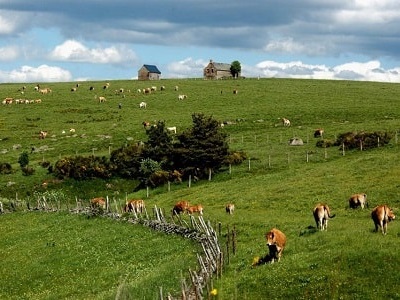 Organization: Nine adults, most of whom were previously unacquainted, walked alongside me for these six days. We traveled from shelter to shelter, carrying all our belongings but staying on a half-board basis. We averaged 24 kilometers in distance and 400 meters of elevation gain each day. A preliminary meeting took place ten days before our departure over a friendly local aperitif. I brought along maps, photographs, and a stag antler found deep in the Aubrac forests, allowing us to already start dreaming of our upcoming encounters.
After reviewing the itinerary, the daily stages, resupply options, and recommended gear, the participants organized their transportation. We set our rendezvous for Monday, October 1st, at the old fairground in Laguiole at 9:30 a.m.
On this first day, we gathered at the feet of the famous Bull, a magnificent bronze monument erected by sculptor Georges Guyot in 1947. This very spot used to host the Aubrac breed cattle markets before the new fairground was established. While some participants recovered from their three-hour drive with a hot coffee, others finished packing their bags and checking their gear. We took our departure photograph and seized the opportunity to discuss the history of Laguiole. I cannot transcribe here everything that was shared during our journey; it would easily fill a book of its own.
As we leave the town and edge closer to the Aubrac plateau, it is essential to highlight its geographical significance at the border of the summer grazing lands. We spoke of its agricultural focus on beef and dairy cattle, and the cooperative dairy that revived the production of Laguiole cheese and fresh tome—essential for making aligot—after the traditional buronniers disappeared. We also touched upon the history of the iconic Laguiole knife, still a favorite among top Parisian bistro owners, the historical migration of the “bougnats” to Paris, and the enduring connection maintained with the capital. Laguiole's etymology traces back to "La Glesiola," a small church originally dependent on a neighboring parish. We admired its sturdy basalt and granite houses and discussed the livelihoods of its thousand inhabitants today. We finally set off—admittedly a bit late, at 10:40 a.m. We quickly ascended above the town, admiring the solid slate roofs dominated by the church. The latter is aptly named "The Fort," a nod to both its strategic location and its fortified history.
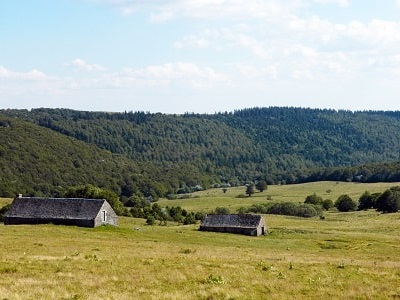 We are already walking in wide-open spaces, bordered by low stone walls and grazing cows, ascending steadily under the weight of our packs. The trail leads us onto a small road toward a final isolated farm, from where we can spot the modern, glass-and-steel establishment of Michel Bras—one of France’s greatest chefs, a man deeply in love with Aubrac, a passion he masterfully translates onto his plates.
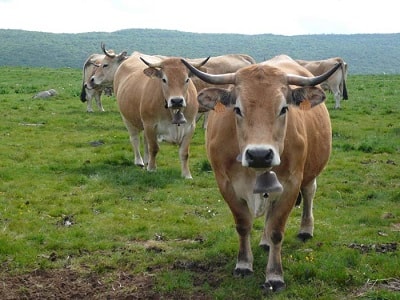
Nearby, we encounter a magnificent Aubrac bull in flesh and muscle. His massive, dark build, tinged with deep blacks, almost evokes a bison. He stands surrounded by his beautiful feminine companions, recognizable by their fawn coats and eyes seemingly outlined with dark mascara.
The hardiness of the Aubrac breed and its exceptional maternal qualities saved these cows from near extinction, a time when they were almost entirely replaced by more profitable dairy breeds. Even today, their meat rightfully holds the prestigious "Fleur d'Aubrac" designation, and as we walk, it becomes clear that they have triumphantly reclaimed their ancestral summer pastures.
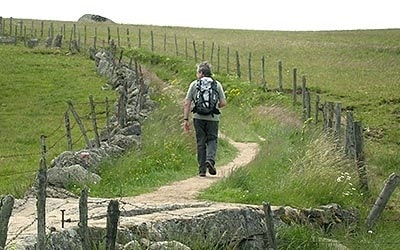
A traditional drover's path dictates the rhythm of our steps for a while. These wide, ancient transhumance routes have crisscrossed the landscape since time immemorial, tracing the paths of herdsmen who led their cattle toward the cool summer pastures. It is the perfect moment to delve into the human history of Aubrac—its scattered forests, its unforgiving climate, and yet, its historical significance as a thoroughfare for drovers, Roman roads, and the famous Route of Santiago de Compostela (GR®65). We discuss the founding of the Aubrac monastery and the accelerated clearing of the region’s primitive forests, eventually reaching the Croix du Pal, where we prepare to enter the woods for a few immersive hours.
 The predominant tree here is the beech. While stunted and sculpted by fierce elements on the exposed heights, the state forest we traverse today descends into the boraldes—steep-sided valleys—and the sheltered slopes leading south toward the Lot Valley. Down here, the beeches grow tall and majestic, their leaves beginning to glow with warm autumn colors. The well-cleared undergrowth is undeniably inhabited: we spot numerous deer tracks and the distinct path of a wild boar. These sightings provide wonderful opportunities to study animal tracks, and Jean-Michel, equipped with a digital camera, enthusiastically captures the moments, allowing us to review our finds in real-time.
Already, two does have furtively crossed our path. During our lunch break, the powerful roar of a stag echoes unexpectedly in the middle of the day—what incredible luck! We continue to find fresh tracks everywhere and catch fleeting glimpses of two more does, followed shortly by another pair accompanied by a stag. Did he have three or four tines on his antlers? He vanished too quickly for us to tell. Throughout our walk in the forest, we genuinely feel surrounded by wildlife. It is true that we are navigating a highly sensitive area, classified as a "quiet zone" by the National Forestry Office (ONF) from September 15th to October 15th. While deer are frequently spotted along the edges of this restricted zone, today we are crossing right through its heart along a marked and permitted trail. We proceed with the utmost discretion out of respect for this fascinating company; their presence is a constant auditory and sometimes visual enchantment.
 Our path winds through a shadowy, dense underbrush, only occasionally emerging to offer sweeping, infinite views over grassy expanses dotted with cows. In the distance, the contrasting light illuminates the Lot Valley and stretches far beyond Rodez. I search in vain for the cathedral’s belfry, which can sometimes be spotted on clear days, but today, a milky haze obscures it, and we quickly retreat back into the quiet shelter of the woods. It is no surprise that people have historically sought refuge here. A Cross of Lorraine at the Enguilhens cave—a small natural shelter along our route—serves as a poignant reminder: a Resistance maquis group hid here during the Second World War, and over two centuries ago, a refractory priest sought sanctuary in these very same depths.
We also take an interest in the diverse forest species intermingled with the dominant beeches: spruce and Douglas fir plantations stand tall, while rowans grace our lunch clearing, oddly accompanied by two oaks and a maple that seemed to have sprouted here by chance. Finally, we step out into bright sunlight, beginning our descent toward Saint-Chély-d'Aubrac and its boralde—the local term for the steep streams cascading from the plateau down into the Lot River. The grass here is remarkably greener and meticulously mowed, with fields neatly divided by stone walls and fences. Down below, we catch a glimpse of the village of Belveze as we cross the departmental road, leaving the high summer pastures and dense forests behind for a noticeably more frequented world. The slope gently eases, bringing us into valleys where communities settled and cultivated the land. Two snakes, moving too swiftly to be identified, dart away from our boots as we pause to take in this newly unveiled landscape.
 The horizon is dominated by the volcanic neck of Belveze. A closer look reveals striking volcanic rock formations and scattered volcanic stones, offering a perfect opportunity to discuss the geological formation of Aubrac. First, the sedimentation around the primitive continent underwent deep metamorphosis, forming the original Hercynian basement composed of schists, micaschists, and gneiss. The subsequent melting and slow cooling of these rocks created a massive granite batholith. Later, a collapse along the Lot fault led to the extensive erosion of this granitic massif. The tectonic disturbances associated with the Alpine uplift were followed by a prominent volcanic phase—visible right here—occurring between 10 and 6 million years ago. This phase was characterized by lava effusions along a northwest-southeast axis, forming the highest peaks of Aubrac, accompanied by explosive eruptive activity that projected volcanic bombs and shaped the dramatic necks we see today.
On the summit towering above us lie the remnants of a structure whose original purpose escapes me. I pose the question to an elderly local we meet in the village, but he is more inclined to lament the creeping desertification of the area, noting that only a single farmer remains where there were once ten. He does, however, point out a local spring, playfully crediting its waters for the longevity of a neighboring couple who both reached the age of 90 before modern plumbing was installed. Unfortunately, today the water carries a faint, unpleasant scent of fuel oil, making it less than appealing! The group also takes an interest in his current task: he is carefully trimming ash trees to feed his livestock. We resume our descent along the ancient path leading to Saint-Chély. Once an essential thoroughfare for the village, it is now a quiet trail flanked by two old stone walls, slowly being reclaimed by vegetation. Used almost exclusively by hikers today, it nevertheless successfully leads us straight to our shelter for the night! Along the way, we pause to admire a beautifully preserved old schist building, a characteristic stone often found as one nears the Lot valley. By descending in altitude, we have effectively changed both landscapes and geological eras. Oaks and ashes have now become the dominant tree species.
A cozy shelter welcomes us for our first evening. We have officially joined the Way of Saint James of Compostela, specifically the route originating from Le Puy-en-Velay. Our physical journey across this landscape inherently leads us back in time. Here, much like travelers have done for over a thousand years—driven by different motivations and enduring vastly different conditions, yet always relying on the strength of their legs—we are opened to an entirely new dimension. Since meals are not provided at the shelter, a hearty dinner at a local restaurant awaits us.
 Most of the group takes the opportunity to indulge in local flavors: a gentian apéritif or a unique cocktail made from chestnut liqueur mixed with white wine from Entraygues; an Aveyron-style Roquefort quiche; tripoux, Laguiole cheese, and soft pérail. Dessert features wonderful blueberry and raspberry tarts, all perfectly accompanied by a robust red wine from Entraygues (one of our Aveyronnais companions had already delightfully introduced us to Marcillac wine at lunch). Following the meal, a digestive stroll through the dark, deserted streets of Saint-Chély-d'Aubrac feels mandatory. Faded inscriptions on stone facades and old shop fronts stand as quiet witnesses to a once-bustling commercial life. The communal washhouse, a few half-timbered houses, the beautiful 15th-century church, and even the heavy iron bars on the ground-floor windows of our accommodation all whisper stories of the past. Exhausted but happy after covering 22 kilometers and accumulating 600 meters of elevation change, our eyelids finally grow heavy.
The next morning, we are up by 7:00 a.m. After communally preparing and enjoying breakfast, our symbolic departure takes place at the Pilgrims' Bridge—though we are heading uphill, against the traditional flow of the pilgrims! Ongoing restoration work on the charming old bridge does not deter us from admiring the historic stone cross, which features an armed Saint James gripping his staff, with the iconic scallop shell watching over all who pass by. We ascend a path lined with dry basalt stone walls, following first the left bank and then the right bank of the river, steadily making our way toward Aubrac.
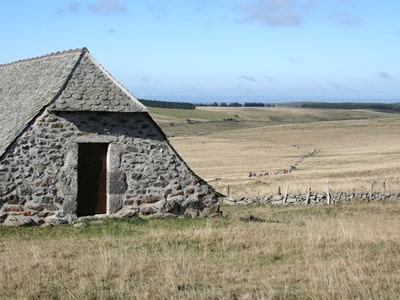
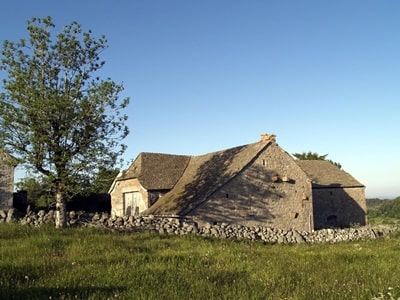
We pass by a few beautifully isolated farms before reaching the high pastures. We pause to admire their massive, imposing structures made of granite and basalt, topped with thick slate tiles resting on formidable oak frameworks. The roofs are steeply pitched, perfectly designed to shed heavy winter snow. The layout is brilliantly practical: the residential quarters sit perpendicular to the barn and stable, allowing the inhabitants to pass directly from the stable to the kitchen, capturing the animals' body heat during the bitter winters. Ingenious hatches allow hay to be dropped directly from the upper storage into the troughs below. In summer, the upper hayloft is accessed directly from ground level at the rear, as one entire side of the building is cleverly built into the hillside. This semi-buried design means the kitchen’s cellar is naturally insulated deep within the earth. The thick stone walls offer exceptional protection against the freezing cold in winter and the sweltering heat in summer. This highly functional architectural style was actively used until about thirty years ago, when the need to accommodate larger herds and modern machinery forced an evolution in farming practices, sadly leading to the gradual abandonment of these traditional structures.
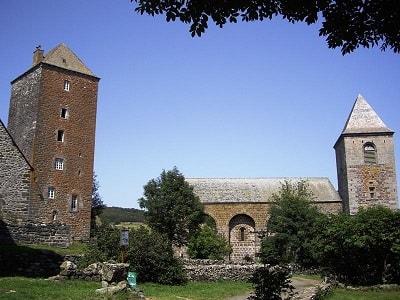 Soon, the historic Aubrac monastery comes into view, founded in the 12th century by a Flemish nobleman to provide sanctuary and care for Pilgrims of Compostela traversing this harsh, unpredictable, and often dangerous region. The surviving buildings today offer only a modest glimpse into the site's former grandeur. This monastery-hospital held immense influence from the 13th to the 17th centuries, with its administrative reach extending far beyond the region (reaching as far as L'Isle-en-Dodon, for example). Monks, nurses, and knights operated in harmony, fulfilling religious, medical, and protective roles. We honor this rich past by quietly visiting the church, though we are slightly pressed for time: a highly anticipated aligot awaits us up in the mountains at an authentic buron. The word "aligot" is said to derive from the Latin "aliquod," meaning "something." Pilgrims crossing the Aubrac on what is now the GR®65 would stop and ask the monks for "something" to eat. Before the introduction of potatoes, this hearty sustenance was likely a rich blend of melted cheese and bread.
The traditional buron, or mazuc, is intrinsically tied to the practice of transhumance. We discuss this seasonal rhythm: the ascent of the herds on May 23rd and their descent on October 13th, the meticulous organization of daily life in these small stone buildings scattered across the mountains, their unique architecture, and their unfortunate decline. We are fortunate to visit one of the very last functioning burons. Here, the cantalès (the master cheese maker) still oversees the artisanal production of fourme and tome, assisted by two younger apprentices. Passing travelers can enjoy an incredibly fresh aligot prepared right on the spot—provided they bring their own cutlery, bread, drinks, and side dishes. Since we are traveling slightly off-season, we are the only customers present. Arriving a bit late for our reservation, the initial atmosphere is noticeably tense; the owner is stern, vigorously complaining in the local patois over the phone that our delayed presence is disrupting his schedule.
 I take the opportunity to gently inform him that some members of our group are originally from Aveyron and have understood every word of his colourful remarks. Intrigued, he asks where they are from, and we quickly discover mutual acquaintances. The tension instantly melts away, replaced by an animated, jovial conversation. He shares stories of his youth, having started as a "roul" (an apprentice or general helper) at the tender age of 11. Back then, he was the buron’s handyman, working under the pastre (head shepherd) who managed the herd, and the bédelier, who tended to the calves and handled the milking. He proudly recounts his steady rise through the ranks, balancing summers in the high pastures with harsh winters spent working as a bougnat in Paris.
In this remarkable setting, it truly feels as though we have stepped back in time. The aligot is masterfully stretched and heated over an open hearth situated at ground level, while chickens boldly peck around the open door. The floor is simple packed earth, and the room is filled with traditional tools: drainers, heavy wooden presses, cheese molds, and various other authentic equipment. A door on the side opens into the cool cellar dug directly into the hillside. Even the strict hierarchy among the workers reflects a bygone era. The aligot itself takes on an extraordinary, unforgettable flavor here—no doubt enhanced by the physical effort we expended to reach it! It flows beautifully from the cast-iron pot to our plates, and from our plates to our delighted taste buds. While our host prepares to load the pig he has raised all season on leftover whey into a trailer next to the buron, we gear up and set off once more. Our path winds through herds of serene Aubrac cows, across gently rolling expanses that seem to merge seamlessly with the vast sky at the horizon. The landscape is beautifully dotted with ancient peat bogs and shimmering lakes.
These vast, sweeping horizons are the product of slow erosion that took place over 4 million years at the end of the Tertiary period, followed by the immense weight of a vast ice cap during the Quaternary glaciations. When the ice finally retreated between 15,000 and 10,000 years ago, it carved out the deep valleys found in the southern part of Aubrac, leaving behind glacial deposits, natural lakes, and massive erratic boulders scattered across the broad, open valleys.
The resulting depressions now host the region’s vital peat bogs—natural reservoirs of water and organic material that support a botanical richness unmatched in Europe (including the fascinating, carnivorous sundew plant). While we avoid trampling these fragile, spongy ecosystems, we can easily admire the stunning lakes of Souveyrols and Salhiens from the trail. We also take a moment to recount the mythical legends surrounding Saint Andréol, without venturing directly to the site. The deep color of the lakes, reflecting a blue sky dotted with soft gray clouds, contrasts breathtakingly with the fiery, reddish hues of the surrounding beech woods. The biting wind continuously sweeps over us... One can easily imagine that travelers on the ancient Roman road, whose path we occasionally tread, were equally enchanted by these waters, perhaps inspiring the pagan cults that once revered them as mystical forces.
 A short detour to the spectacular Deroc waterfall, where the water plunges dramatically over imposing basalt columns, offers a completely different, vertiginous perspective before we finally reach our evening stage. Tonight's accommodation is significantly more luxurious, though the welcome feels a bit more commercial than our previous charmingly rustic shelter. We are staying in a beautifully renovated gîte-hotel, masterfully restored from the ruins of an isolated old farm. We admire the grand stone fireplace and the carefully curated antique objects displayed throughout the rooms. Fresh bread and traditional fouace are still baked on-site in the original stone oven. Our gastronomic journey continues brilliantly, and our collective wine knowledge is further enriched! Eager to earn such a feast, a few energetic participants decide to join me for an extra 2.5-kilometer walk to Nasbinals, where we admire the striking granite village and its beautiful, sturdy Romanesque church. Even after covering 24 kilometers and climbing 660 meters earlier in the day, these six participants still have energy to spare. A well-deserved local aperitif in the village serves as the perfect reward.
Thick fog has draped the land overnight. Fortified by sweet fouace and delicious homemade jams at breakfast, we set out at a brisk pace for a relatively flat, 23-kilometer stage towards Aumont-Aubrac, located on the far eastern edge of the massif. As we progress, the basalt slowly vanishes, replaced by massive erratic granite blocks that decorate the rolling pastures. We are officially entering the "Land of Peyre"—the land of stone. Dry stone walls become omnipresent, forming endless geometric lines that vanish mysteriously into the thick fog. Large, rounded granite boulders, smoothed by millennia of erosion, loom out of the opacity. We feel entirely enveloped in the middle of nowhere, wandering through an ethereal, almost fantastical landscape.
The very few villages we pass through seem entirely deserted; the widely spaced houses stand like silent stone sentinels, frozen in time and slowly weathering away. Everything here is built to endure: the fence posts, the traditional "travails" (frames used for shoeing oxen), the communal bread ovens, and the heavy watering troughs are all carved from solid granite, seemingly waiting for eternity for the people to return.
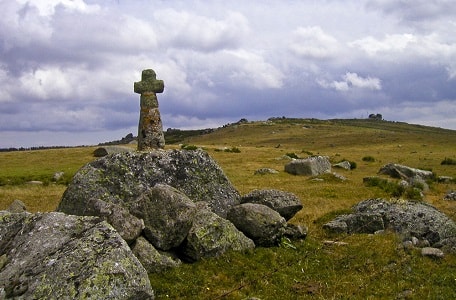
 The Romans once placed granite markers along their roads to guide travelers, but over the centuries, the paths have shifted, and the ancient markers now blend seamlessly into the chaotic scatter of natural stones. A small, sturdy stone bridge allows us to cross a lazy, meandering river—the waters flow slowly here, as this part of Aubrac is remarkably flat. This stream will eventually join the Bès, the only major watercourse draining northwards from the great plateau, standing in stark contrast to the steep, rushing boraldes that plunge southwards on the opposite side of the Aubrac ridge. This vast, exposed northeast-facing slope explains the extreme harshness of the local climate; there is absolutely nothing here to break the fierce winds.
Very few people have managed to remain in this environment. The land feels fiercely autonomous, intoxicated by the endless air and open space, permitting only the indestructible mineral world of granite to reside beneath its sky, while granting the cows total freedom during the summer months. The enveloping fog suits this landscape perfectly; stones and cattle emerge like ghosts from the mist, the endless walls seem to dissolve into nothingness, and our wandering minds eagerly follow suit. This is exactly how I prefer this land—for the profound sense of escape it offers, and for the undeniable feeling of pure freedom it provides. I genuinely hope, and believe, that my companions on the trail felt this powerful connection as well.
The fog finally begins to lift as we draw closer to the Land of Peyre, nearing Aumont-Aubrac. Dense forests of Scots pines, with their distinctive salmon-colored trunks, have now replaced the open pastures and provide a perfect, sheltered spot for our picnic. Shortly after, signs of civilization return: active farms and carefully cultivated fields begin to appear. While dairy farming remains present, this area also specializes in raising Charolais crosses for high-quality beef, as well as breeding horses.
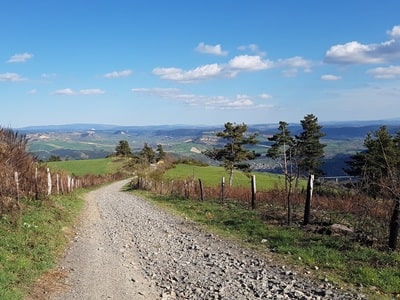 Arriving in the town is slightly jarring after days of isolation, with the sudden presence of the highway and the railway line. However, we quickly console ourselves with the thought that this modern infrastructure—connecting Aubrac directly to Paris in just five hours—is a vital economic lifeline for the region. We arrive quite early. I had initially planned this shorter, mid-journey stage to allow everyone some individual rest, time to write postcards, or to run errands, especially since we had barely seen an open shop since our departure. In reality, the group has become incredibly tight-knit. While I accompany Gisèle to a supermarket a few kilometers away (the local grocery store being closed) to buy fresh fruit, the rest of the group explores the village together. We eventually find them gathered in a cozy local bar, happily chatting with residents who are thrilled to share stories about local life.
The first heavy drops of an impending storm—whose dark clouds had slowly overtaken the previously brilliant blue sky—begin to fall just as we return to our gîte. Our accommodation is a charmingly simple, converted old farm. The dining room is located in the former stable, where an old milking machine and a heavy wooden yoke are still proudly displayed on the walls. We enjoy a warm, joyful dinner, sharing stories and laughter with other hikers traveling the Way of Saint James.
The lighthearted lesson of the evening involves a traditional local toast: "Oh you, poison of Saint James, you who trouble our reason, you say nothing, miserable one. So, you are guilty. Off you go, straight into prison!" With these playful words, we raise our glasses and enthusiastically toast with our neighbors! Earlier, another pilgrim spotted near the church had chosen a much harder path, perhaps more in tune with medieval times: he was preparing to sleep rough outdoors despite the incoming rain, meticulously tending to his heavily blistered feet. Witnessing this sparks a deep philosophical discussion led by Magali regarding the fundamental nature of walking, and the complex relationship between pure pleasure, physical effort, and even suffering. A few among our own ranks are also beginning to feel the physical toll of the journey, though fortunately nothing too severe; our well-stocked first aid kit proves highly useful. Later in the evening, I step outside to observe the sky. The bright full moon shines clearly through the damp, post-storm air, promising a beautifully clear day tomorrow.
Fourth Day: From Aumont-Aubrac to Fournels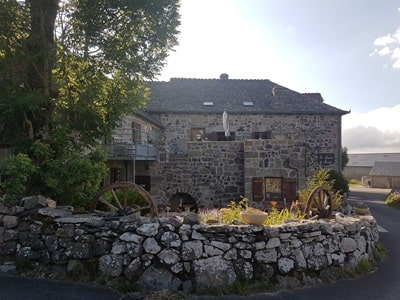 On this Thursday, the fourth day of our adventure, a light morning mist quickly burns off, creating a beautiful play of light and shadow across a slightly less rugged landscape. Rolling, cultivated farmlands now gracefully alternate with dense pine forests. Along the fences, intricate spider webs heavily laden with morning dew sparkle brilliantly between the strands of barbed wire as the sun burns away the last traces of fog. We spot a large, vibrantly colored spider sitting proudly in the center of one of these webs, prompting Jean-Michel to carefully capture its labyrinthine masterpiece on camera.
We walk briskly along wide dirt paths, occasionally crossing short stretches of asphalt. Traditional granite farms seamlessly blend with more modern agricultural buildings, while the green pastures are frequently interspersed with freshly plowed fields, signaling the onset of autumn work. Dairy farming is highly prominent here, supported by a small, active local dairy in Aumont.
We frequently pass large stacks of wrapped forage bales gleaming in black or white plastic film, which our resident photographer cleverly uses as subjects for some highly artistic, modern photographic compositions! We soon pass a beautiful old stone mill situated on the Rimeize, a gentle stream, reminding us that for centuries, hydraulic power was the sole reliable source of energy available to drive any sort of machinery. We take a moment to carefully examine the weir and the diversion channels that historically directed the rushing water beneath the building, forcefully turning the grand wheel connected to the heavy grinding stones above.
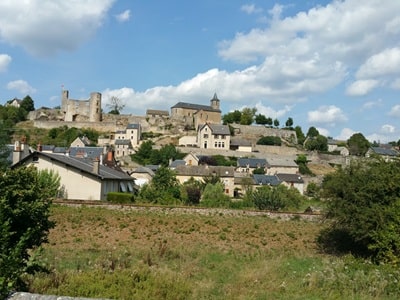 Watermills have been an integral, heartbeat-like component of rural life here since ancient times. Their use in this region actually predates the Christian era, with the Romans introducing sophisticated vertical wheel mills. I realize now that I failed to point them out when we were walking through the steep boralde of Saint-Chély-d’Aubrac, where their concentration was truly astonishing. The rich history surrounding their transmission through generations, as well as the strict, complex regulations governing the duties and rights of the miller in relation to the local population and nobility, is absolutely fascinating.
Arriving in Fau-de-Peyre, we take time to admire the stunning village church and its highly characteristic comb-shaped bell tower (clocher à peigne). We notice immediately that it is missing one of its bells. We will later learn the historical explanation for this during our afternoon stop at La Fage-Saint-Julien from a knowledgeable local: many of these rural bell towers lost one or two of their bronze bells during various wars, particularly in the 19th century, when they were ruthlessly requisitioned and melted down to cast cannons. From here, our journey continues. We briefly leave the pine forests for lush, grassy meadows bordered by imposing oaks and ashes, occasionally passing solitary apple or chestnut trees. The trail steadily leads us back up towards the heights of Truc de l’Homme ("Truc" being a common local term for a prominent peak) at nearly 1,274 meters in altitude. The path, brilliantly bordered by blooming yellow gorse, guides us into a cool, dense coniferous forest, providing the perfect setting for our midday lunch break.
The forest transitions from predominantly Scots pines to extensive Douglas fir plantations, mixed with spruces, mature larches, vibrant young larches, and a few scattered broadleaf trees. The forest floor is covered in a vibrant, impossibly green mossy carpet, heavily dotted with striking, red-and-white fly agarics, alongside various other unidentified white mushrooms, which Marc crouches down to observe with great curiosity. Throughout the morning, we had already passed several giant puffballs, field mushrooms, various inedible boletes, and, of course, highly prized pine porcini—often closely trailed by determined local mushroom hunters!
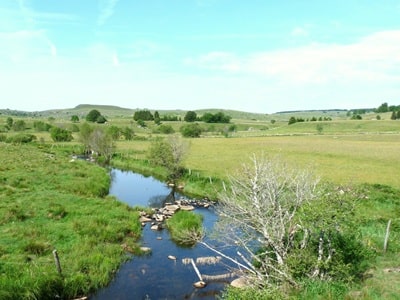 Just as we begin to pack up and depart, a small viper momentarily blocks our path, quickly slithering away into the underbrush. During the afternoon, crossing through the picturesque villages of La Fage-Saint-Julien and Termes allows us to admire beautifully restored stone buildings. Because this region boasts a milder climate and is easily accessible from the larger town of Saint-Chély-d’Apcher, the traditional architecture has been lovingly and meticulously maintained.
The striking church of Termes sits proudly on a high promontory, which we reach under a flawlessly clear, brilliant blue sky. From this incredible vantage point, we are treated to a sweeping, panoramic view encompassing the entire Plomb du Cantal mountain range, the distant Monts de la Margeride, and the Aubrac plateau itself, partially masked by the imposing silhouette of Le Truc de l’Homme. Far below, we can trace the winding valley of the river Bès, and slightly closer, we spot the specific valley cradling Fournels, our final destination for the day. Having covered 24 kilometers with a gentle 500 meters of elevation gain, we feel fantastic. A friendly local resident spontaneously improvises as our guide, detailing every peak and valley to Magali, Jean-Michel, Laurent, and me as we stand perched on the belvedere, utterly captivated by the spectacular view.
The final descent into the village is swift and easy. We are thrilled to discover that we have the entire gîte to ourselves. Philippe quickly sets to work lighting a crackling fire in the massive granite fireplace, using the dry wood thoughtfully provided by the caretaker. This warm, inviting hearth becomes the perfect gathering spot for a convivial evening, enhanced by a delicious, soothing honey punch we purchased earlier in the day from a local beekeeper.
For dinner, we head out to "Chez Tintin," a remarkably welcoming establishment run by the gîte's warden. The intimate restaurant room, situated just off an equally cozy bar, is filled with mouth-watering aromas, perfectly matching the exceptionally warm and genuine hospitality of our host.
 For a very reasonable price, we are treated to an incredibly generous, authentic worker's meal: a hearty homemade vegetable soup, a fresh mixed salad accompanied by unlimited traditional fricandeau, perfectly cooked lentils flavored with savory salted pork, a tender slice of local Aubrac beef, a generous platter of regional cheeses, and a classic chocolate éclair to finish. The master of the house manages absolutely everything himself—expertly cooking, warmly serving the tables, and jovially chatting with the regulars at the bar. It is a truly memorable place that I highly recommend.
As we leave the restaurant, we notice the door to the village church, situated right next to our gîte, is wide open in the middle of the night. It is a beautiful testament to the absolute peace and security of this quiet town of barely 400 souls! Back at the gîte, settled comfortably before the dying embers of the fire, we partake in our now-ritual evening herbal tea, a comforting tradition that has beautifully punctuated the end of every day since we began our journey.
Tonight, however, I need to spend a little time reassuring the troops and de-dramatizing tomorrow’s daunting stage. Philippe, having thoroughly studied the topo-guide, has inadvertently managed to slightly terrify the group! Once everyone is asleep and the fire has completely died down, I pull out the map to carefully study our options. Up until now, I have never forced the group to strictly follow the official marked route in its entirety; I have prioritized showing them the specific, magical aspects of Aubrac I wanted them to experience, always taking into account our allocated time and the collective physical state of our legs. But tomorrow’s stage, even with every possible shortcut factored in, will undoubtedly be long and demanding: a full 31 kilometers with 600 meters of cumulative elevation gain.
 We have already reached the penultimate day of our adventure. Our departure is only slightly earlier than usual; by a reasonable 8:30 a.m., we leave behind the scattered stone houses and the striking comb-shaped bell tower of Fournels. The route initially takes us on a slight detour to the north, heading towards the dramatic entrance of the Bès gorges at Saint-Juéry, a highly symbolic geographical border.
A tiny, winding paved road rises and falls as it closely follows the meandering Bédaule stream. We pass by several old watermills, noting with pleasure that one is currently undergoing careful restoration. The path eventually veers toward Saint-Juéry, a picturesque village that we can only admire from the tight bends of the road high above. I secretly wish we had the time to descend into the valley to see the rushing Bès river up close, along with its ancient stone bridge and historic cross, but I know the group is not keen on adding any extra distance today. Therefore, we maintain a strong, steady pace. The trail weaves through fragrant coniferous woods, frequently opening up into bright, grassy meadows that offer expansive views. We catch charming glimpses of Chauchailles and Chauchaillette—two small villages whose wonderfully melodic names had fascinated Jean-Michel so much that he had already spoken to me about them back in Toulouse!
The "Old Road" leading up to Cheylaret is undeniably charming. A thick carpet of crisp autumn leaves crunches satisfyingly beneath our boots under the majestic beeches, though the resilient grass is already preparing to reclaim the path. Jean-Pierre casually peels a few fallen beech nuts to extract and eat the small akenes. It is true that historically, locals pressed these nuts to produce cooking oil, so they are perfectly edible and nutritious.
Speaking of foraging, ants are technically edible too! We pass several massive anthills in this forested area, one of which stands taller than any of us! I am well aware that the abdomen of these specific insects can be eaten and has a sharp, vinegary taste, but I am certainly not ready to demonstrate that to the group today!
 The impressive Cheylaret rock is a massive, flat lava table stretching several dozen meters long, towering formidably at 1,128 meters in altitude near the village of La Chaldette. This village, as its name cleverly suggests, boasts a natural hot thermal spring. These two striking geological features stand as powerful testaments to the fact that the Aubrac plateau has maintained, and continues to maintain, deep, fiery connections with the very heart of the Earth.
In Cheylaret, the local inhabitants have done an exceptional job renovating their historical heritage. The traditional livestock watering troughs and the central stone fountain—where the entire village once gathered to fetch their daily water before modern plumbing arrived—have been beautifully restored. They have also preserved the heavy granite "travail" and the essential communal bread oven, carefully sheltered at the back of a sturdy stone cabin, highlighting a communal way of life that once defined the entire region.
We will continuously observe this highly specific, practical village layout in the subsequent hamlets we cross: the "travail" for shoeing animals, and the communal oven, accessed by pushing open a heavy wooden door that leads into a small, warm room flanked by two stone benches, with the deep oven door set firmly into the back wall. These essential elements were always constructed in what served as the central village square. In Cheylaret, this "square" is now merely a small, quiet, cleared space between the ancient houses.
A large, carved stone cross also stands prominently here, serving as the spiritual heart of the village in the absence of a formal church. A small, informative panel reminds passersby of the once-vital function of this now-deserted crossroads; bustling agricultural fairs were historically held right here, in this small intersection near the fountain, which now serves as an idyllic, peaceful spot for our lunch break.
 We decide to push on and take our coffee break at La Chaldette, just a few kilometers further down the trail. The natural hot spring I fondly remember flowing freely into a rustic old washhouse has unfortunately been completely enclosed and integrated into a brand-new, highly modernized thermal spa center. While visitors can easily access the facilities during the busy summer months, one of the locals casually informs us that during the winter closure, the residents completely lose access to their own village’s hot spring! Undeterred, a few curious members of our group decide to taste the strongly sulfurous water—renowned for its use in weight-loss treatments—joking loudly as they drink to the amusement of those who wisely opted to remain safely seated on the café terrace! The tepid, highly mineralized water gushes steadily from three small metal spouts integrated into a modern fountain inside a contemporary building, unmistakably carrying the sharp, clinical odor of a hospital!
It is fascinating to think that here, right in the rugged heart of Aubrac, in a tiny village consisting of barely two hotels, a single café-restaurant, and a handful of houses that are sometimes completely cut off by heavy winter snows, professional healthcare personnel are actively at work! Yet, the historic stone washhouse outside remains sadly and desperately dry... After generously gifting some superb pine porcini we found earlier in the morning to two delighted, amateur spa-goers, we finally leave this pocket of "relative civilization" and the meandering Bès river behind. We strike out to rejoin the vast, high summer pastures. We are quickly greeted by the plateau’s iconic reddish inhabitants; one particularly stubborn cow decides to block our path, forcing us to jog lightly through the thick heath to safely bypass her. From this point on, there is absolutely nothing left but the immense sky, the gentle, rolling curves of the earth, the scattered herds, and us. This profound, sweeping solitude is an absolute delight; the group falls into a thoughtful, contemplative silence, entirely forgetting the long distance remaining. High above us, a solitary buzzard effortlessly rides the thermals, its majestic, silent gliding seeming to carry our spirits even further and higher into the crisp air.
I have yet to mention the rich birdlife, but every single day has offered spectacular opportunities to observe various raptors—buzzards, red kites, and swift falcons gracefully patrolling the skies. A chorus of smaller birds has constantly accompanied us with their diverse, melodic songs; just yesterday, we even found a tiny, newly fledged bird resting on the very edge of our path. The trail through this seemingly deserted landscape eventually leads us to two tiny, remote hamlets. The few astonished inhabitants we meet quickly confirm that we are indeed correctly following a local shortcut heading straight towards Saint-Urcize.
A steady descent back into the mountains eventually brings us to the main road crossing the Bès river. We merge onto a slightly wider route, and finally, we arrive in the cantonal village of Saint-Urcize. We have officially entered Cantal, marking the third and final department we will explore after Aveyron and Lozère. These three distinct territories perfectly connect their histories, bishops, and regional identities at the famous Cross of the Three Bishops, located right in the wild heart of Aubrac.
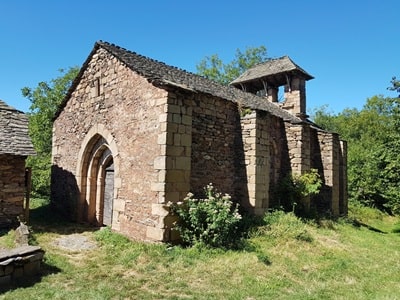 The village of Saint-Urcize beautifully showcases traditional houses built from a striking mix of light granite and dark basalt. The dramatic remnants of ancient volcanism are incredibly prominent in the surrounding landscape, visible in the form of massive dykes, expansive boulder fields, and towering basalt columns. The local architecture brilliantly utilizes these materials: easily workable granite is predominantly used to carve the sturdy surrounds for windows and doors, while the rougher, darker basalt is heavily utilized to construct the thick, insulating walls.
The friendly hotelier responsible for managing our reserved gîte leads us to a charming, self-contained small house. He has beautifully furnished the entire first floor with warm pine wood and traditional mountain artifacts, creating a cozy space complete with a large fireplace insert and a sleeping mezzanine. The atmosphere feels exactly like that of a welcoming alpine chalet. To properly celebrate our arrival and soothe our tired muscles, I highly recommend we try a special local aperitif based on Aubrac tea (calament). Tonight, we enjoy it with a kick of alcohol, rather than as our usual post-dinner herbal tea.
Speaking of local plants, late autumn is admittedly not the ideal botanical season. We can only dream of the legendary fields of fragrant daffodils harvested for the high-end perfumery industry, the towering great yellow gentian traditionally dug up to produce the famous local aperitif, the sweeping, golden expanses of spring jonquils, the rare carnivorous sundews, the elegant purple martagon lilies, and the countless other floral ornaments that spectacularly decorate Aubrac during the warmer, more favorable seasons. Nonetheless, we were still lucky enough to spot a few late-blooming buttercups, bright yellow senecios, delicate yarrow, white clover, lion's tooth, hawkweed, lotier, vibrant gorse, wild carnations, the pale autumn crocus (which one must carefully distinguish from the much safer, highly prized wild saffron), delicate blue veronicas, hardy heather, and scabious. Though perhaps less spectacular, their resilient, late-season blooms provided wonderful bursts of color along the trail.
What our enthusiastic restaurateur managed to find today, however, is significantly more gratifying. Proudly displayed in the center of our dining table sits an absolutely magnificent, flawless Bordeaux porcini mushroom weighing a massive 570 grams! We are absolutely going to eat it—though perhaps not this exact display piece—expertly paired with a steaming, perfectly stretched aligot for our grand final dinner. The evening is spent joyfully discussing fishing adventures around the world, as our host is a truly passionate angler and has turned his dining room into a fascinating, personal museum dedicated to the sport.
Following dinner, a brisk, digestive night walk leads a few of us to the top of the village "donjon," allowing us to quietly admire the breathtakingly clear, star-filled night sky of Aubrac one last time. I even step outside again at four in the morning, having been woken by the stifling heat of the woodstove inside the chalet. As I stand in the cool night air, the distant, powerful roar of a stag echoes down toward the village—a truly magnificent, wild farewell.
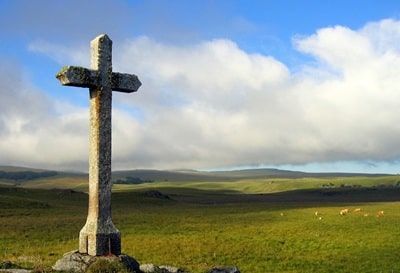 Saturday marks our final day on the trail. As if participating in a melancholic farewell ritual, we climb back up the same steep steps we descended yesterday to enjoy one last, deeply contemplative panoramic view over Saint-Urcize. We watch the morning light gently shift from the cool gray of the slate tiles to the rich, vibrant greens of the surrounding earth, all set beneath a piercingly blue sky. Today’s stage has been intentionally kept short, ensuring we have plenty of time to leisurely stroll through the streets of Laguiole—our ultimate final destination—before everyone must head home. We have a mere 17 kilometers ahead of us, featuring almost negligible elevation gain. Unfortunately, a painful flare-up of tendonitis prevents Philippe from completing the final leg on foot; however, he promises to join us several times along the route and for our final picnic, smoothly navigating the small roads by car. This final walk is profoundly enjoyable, allowing us to linger in these almost mythical, wide-open spaces. It even gifts us one final, breathtaking belvedere at 1,342 meters, offering sweeping views directly over the dense woods leading down to Laguiole.
The grazing herds moo loudly as we pass by; they seem to instinctively sense that their own descent back to the valleys is fast approaching. We navigate a few minor obstacles, carefully climbing over barbed-wire fences and watching our step to avoid slipping in the last, glowing beech woods. The soft forest floor is heavily marked with fresh hoof prints, and we cross paths with a group of local hunters. As we sit down for our lunch break, we watch them return to their vehicles empty-handed, which we note with quiet, shared satisfaction!
Emerging from the edge of the woods, we step out into the very last high pastures at the extreme western limits of the Aubrac plateau. Our journey across this magnificent landscape is rapidly drawing to a close, much like our physical journey will end upon reaching the famous Aveyronnais town. Laguiole, undeniably the true capital of the plateau, looms clearly in the distance at the very edge of the horizon. We sit down to share one final, convivial picnic, beautifully accompanied by a few last wine-tasting experiences. We have never once lacked for good wine throughout this trip, entirely thanks to Yannick’s generous foresight—though always enjoyed in moderation, of course! Yet, I believe it is the sweet, golden fouace proudly purchased in Saint-Urcize that ultimately steals the show during this final, joyous sharing of food. Only a gentle, winding road remains to descend before we reach Laguiole, with its world-famous knives, its iconic bronze bull, and its delicious cheese... Here, at the end of the road, our individual destinies must finally part. But is this truly an end, or merely a new beginning?
From the boundless, high-altitude space of the plateau, we slowly descend back into the rhythm of our everyday lives, perhaps returning with our minds and hearts opened to entirely new dimensions. And yet, Aubrac remains beautifully immutable. It will always be there, patiently waiting for us with its shifting colors and infinite, subtle complexities—always ready to challenge us, to test us, and to profoundly enrich our souls...
I deeply hope that our carefully chosen itinerary, the physical efforts we shared, and the breathtaking views we collectively absorbed have allowed each and every one of you to fall in love with these mountains—a landscape to which I personally owe so much. I hope this journey has sparked a burning desire to return, to explore other hidden corners, and to experience new, meaningful encounters with the humble, serene, and steady gaze that this Aubrac inherently conveys. For me, this trip was a profoundly moving experience that went far beyond mere logistical preparation and guiding. It was a genuine search for total immersion in the soul of a country, a joyful sharing of a deeply personal perspective, and a quiet, attentive listening to the individual journeys of each person as they moved through these vast spaces. I sincerely hope this experience serves to foreshadow other upcoming trips, continually refining our approach to travel... A sweet, lingering music and a vivid flood of spacious imagery fill my heart every single time I think of these mountains. I urge you: let yourself be truly carried away into the vibrant, beating life of this remarkable land...
Catherine Revel